Far-red radiation and elevated CO₂ boost biomass accumulation in young leaf lettuce indoors
A new study from scientists at Purdue University reports that far-red radiation, in combination with increased carbon dioxide (CO₂) concentration, significantly enhances biomass production in young leaf lettuce grown under controlled environments, offering practical guidance for indoor farming operators enthusiastic about including far-red in their sole-source lighting recipes.
Phys.org
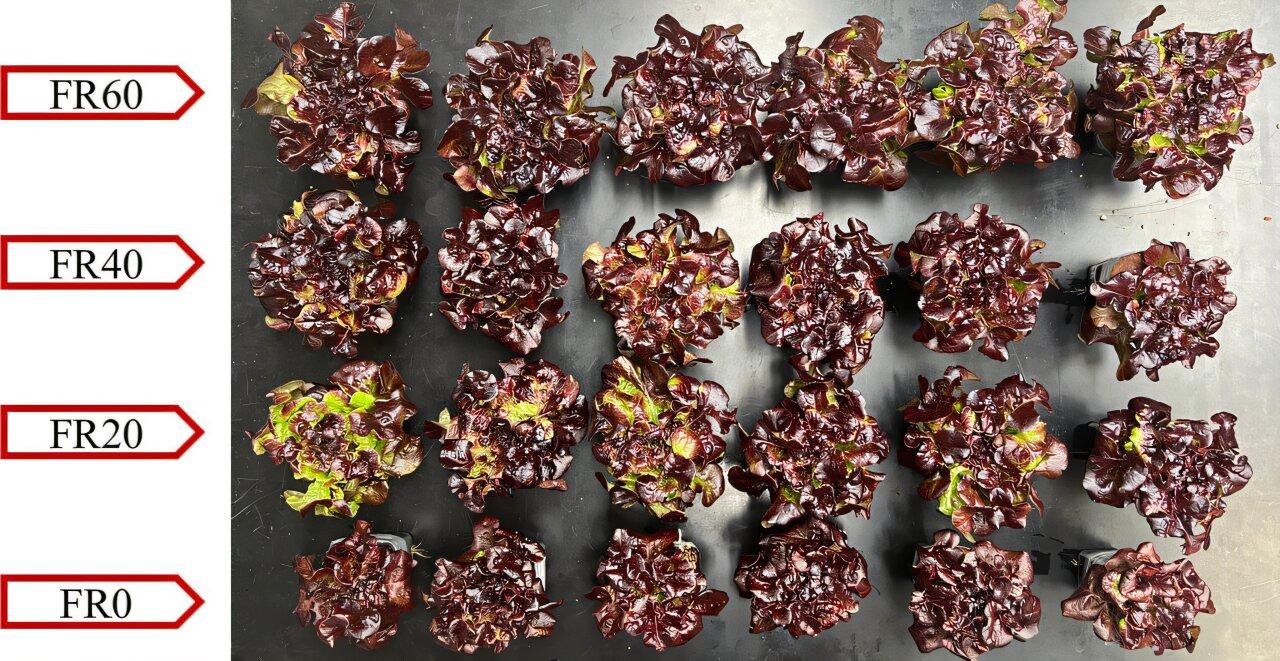
A new study from scientists at Purdue University reports that far-red radiation, in combination with increased carbon dioxide (CO₂) concentration, significantly enhances biomass production in young leaf lettuce grown under controlled environments, offering practical guidance for indoor farming operators enthusiastic about including far-red in their sole-source lighting recipes.
This study was the second phase of a previously published study in which the interaction of these two important environmental inputs was investigated under a more limiting light level commonly used in commercial CEA. Under a light intensity of 200 mol m-2 s-1, the CO2 effect was more pronounced as a main effect. However, findings of the current study indicated that the effect of far-red is enhanced under a moderate total photon flux density of 400 mol m-2 s-1.
Biomass accumulation varied at different stages of development depending on the level of CO2 at which lettuce was grown. While growers often focus on the amount of light delivered to crops, the study demonstrates that which wavelengths are included can be just as important as total light quantity.
Plants exposed to supplemental far-red radiation accumulated substantially more biomass than those grown without far-red. The growth response to far-red became even stronger when plants were also cultivated under elevated CO₂ concentrations. Together, the two factors promoted leaf expansion and foliar canopy development, allowing plants to capture light more effectively and convert it into plant material.
The research indicates that far-red wavelengths improve canopy architecture by stimulating leaf enlargement. Elevated CO₂ further increased photosynthetic efficiency, enabling plants to make better use of available light energy. Importantly, these benefits occurred without increasing total photon flux density, suggesting that growers can improve productivity through lighting-spectrum management rather than simply raising energy input.
Findings also suggest that far-red radiation influenced plant morphology in ways that did not negatively affect crop quality at the young lettuce stage, making the approach particularly relevant for baby-leaf and spring-mix production systems. Because lettuce is widely cultivated in vertical farms and greenhouses, the results provide actionable information for producers balancing energy costs with yield goals.
The study highlights the importance of integrated environmental control—coordinating lighting spectrum and CO₂ enrichment—to optimize plant growth. As controlled-environment agriculture expands, understanding how environmental factors interact will help producers refine production strategies and improve resource efficiency.
This research provides evidence that targeted spectral lighting combined with CO₂ management can increase yield potential in leafy greens production systems while maintaining moderate light levels, offering a pathway to more energy-efficient indoor crop production.
This study was part of a multi-institutional, multidisciplinary initiative called OptimIA (Optimizing Indoor Agriculture), led by Michigan State University and focused on enhancing the productivity, profitability and sustainability of indoor crop production.
Through this project and related research efforts, the Mitchell Lab at Purdue University has made significant contributions to improving resource- and energy-use efficiency in indoor farming. Optimization of environmental inputs investigated in this study represents a key strategy for increasing resource-use efficiency and, ultimately, advancing the productivity, profitability and long-term sustainability of this rapidly expanding industry.
Discover the latest in science, tech, and space with over 100,000 subscribers who rely on Phys.org for daily insights. Sign up for our free newsletter and get updates on breakthroughs, innovations, and research that matter—daily or weekly.
Cary Mitchell is professor emeritus of horticulture and landscape architecture at Purdue University. His research contributions spanned controlled-environment agriculture, plant growth regulation and the development of advanced horticultural technologies.
Senior author Dr. Fatemeh Sheibani is a postdoctoral research associate at Purdue University. Sheibani's main research topic is "enhancing resource-utilization efficiency of indoor farming." With an emphasis on vertical farming, she has been focused on improving the energy-utilization efficiency of light-emitting diodes as the sole source of lighting.
Additional contributors include Celina Gomez, associate professor of controlled environments at Purdue University, and Erik Runkle, professor of horticulture at Michigan State University, focusing on the environmental physiology of herbaceous specialty plants grown in controlled environments.
The work is published in the journal Journal of the American Society for Horticultural Science.
Fatemeh Sheibani et al, Interaction of Far-red Radiation and CO2 Concentration at Moderate Total Photon Flux Density Stimulates Biomass Accumulation in Young Leaf Lettuce, Journal of the American Society for Horticultural Science (2026). DOI: 10.21273/jashs05550-25
Journal information: Journal of the American Society for Horticultural Science
Provided by American Society for Horticultural Science
MA in English, copy editor since 2021 with experience in higher education and health content. Dedicated to trustworthy science news. Full profile →
Master's in physics with research experience. Long-time science news enthusiast. Plays key role in Science X's editorial success. Full profile →
Friday, June 26, 2026