Scientists measure hidden quantum forces that could power a new generation of pharmaceutical drugs
It's one thing to design a pharmaceutical drug. It's another to know if and why it actually works; not on paper or in a computer model, but inside the chaotic world of living systems, where proteins twist into shape, atoms constantly pull and push each other apart, and molecular interactions are the difference between health and disease.
Phys.org
It's one thing to design a pharmaceutical drug. It's another to know if and why it actually works; not on paper or in a computer model, but inside the chaotic world of living systems, where proteins twist into shape, atoms constantly pull and push each other apart, and molecular interactions are the difference between health and disease.
For decades, scientists have known that these interactions are driven by hidden quantum forces. The problem is that, like working blindfolded, they've never been able to measure them directly in biological systems.
Now, that era of blindfolded work may be ending.
Researchers at Texas A&M University's Institute for Quantum Science and Engineering have invented a laser technique called Thermostable Raman Interaction Profiling (TRIP) that can directly measure the quantum forces shaping proteins and how pharmaceutical drugs interact with them.
And when the team tested their new technique on a key coronavirus protein, the results were staggering. Not only did TRIP uncover how the virus's protein physically rearranged itself, it accurately predicted how effectively antiviral drugs would bind to and work against it.
The project, published in Science Advances, offers an unprecedented, real-time view of the atomic forces that shape proteins—while introducing a powerful invention for drug discovery and development.
"For the first time, we can directly measure molecular forces at their most fundamental level," said Dr. Narangerel Altangerel, assistant research scientist in the Department of Electrical and Computer Engineering and lead researcher of the project. "We can directly use these measurements as a predictive tool for drug development, far beyond a single virus or disease."
The real shockwave of TRIP ripples far beyond a single pathogen or even a single disease. The quantum forces TRIP captures are part of the hidden architecture and scaffolding of life itself.
"Proteins are one of the building blocks of life," Altangerel said. "What we are doing is shining a light, literally, on the mechanism that holds them together, which are fundamental to how pharmaceutical drugs work."
This means TRIP isn't just a tool to observe diseases, but an exciting technique for designing treatments against them. In cancer, for example, TRIP could help scientists evaluate drugs capable of disrupting protein networks that drive and spread tumor growth.
In Alzheimer's disease, another case study, it could help evaluate which compounds stabilize healthy proteins in brain cells or detect the earliest changes associated with neurodegeneration.
Across infectious diseases, the same principles apply. Scientists can now directly observe how different pharmaceutical drugs target and weaken the protein machinery viruses rely on, helping identify the strongest candidates long before they reach clinical trials.
"Our technique is noninvasive and can expedite the testing and prescreening of pharmaceutical drugs, with the aim to improve overall human health," said Dr. Philip Hemmer, professor of electrical and computer engineering at the Texas A&M University College of Engineering and close collaborator and author on the study.
For the research community, and the world, these are profound shifts.
"By understanding these quantum interactions directly, we can start designing medicines with a level of precision that wasn't possible before, applied for a spectrum of diseases," said Altangerel.
Ultimately, and for the first time, we are entering an era where therapies aren't developed only to treat a generic condition but could be contoured and engineered around the fundamental forces that drive it.
A future of precision medicine engineered with quantum precision.
Discover the latest in science, tech, and space with over 100,000 subscribers who rely on Phys.org for daily insights. Sign up for our free newsletter and get updates on breakthroughs, innovations, and research that matter—daily or weekly.
Deep inside every living cell, tiny negotiations are constantly underway, and throughout it all, countless ring-shaped molecules drift toward one another, line up and stack like pancakes in a subtle interaction called pi-pi stacking.
No dramatic chemical reaction, no breaking or forming bonds. Just subtle geometry and quantum mechanics quietly working in the background. Yet this hidden force shows up almost everywhere in biology.
"Pi-pi interactions are a cornerstone of biology, materials science and drug design. Think of them as biology's Velcro. They hold the 3D structuring of molecules like DNA and proteins in living systems and play a major role in how medications work," said Hemmer.
Here's the catch: Scientists have spent decades trying to exploit it, but no one has been able to measure these forces directly.
"Current techniques, like X-ray crystallography and mass spectroscopy, while useful, rely on visual intuition and indirect inference rather than direct measurement," Altangerel said.
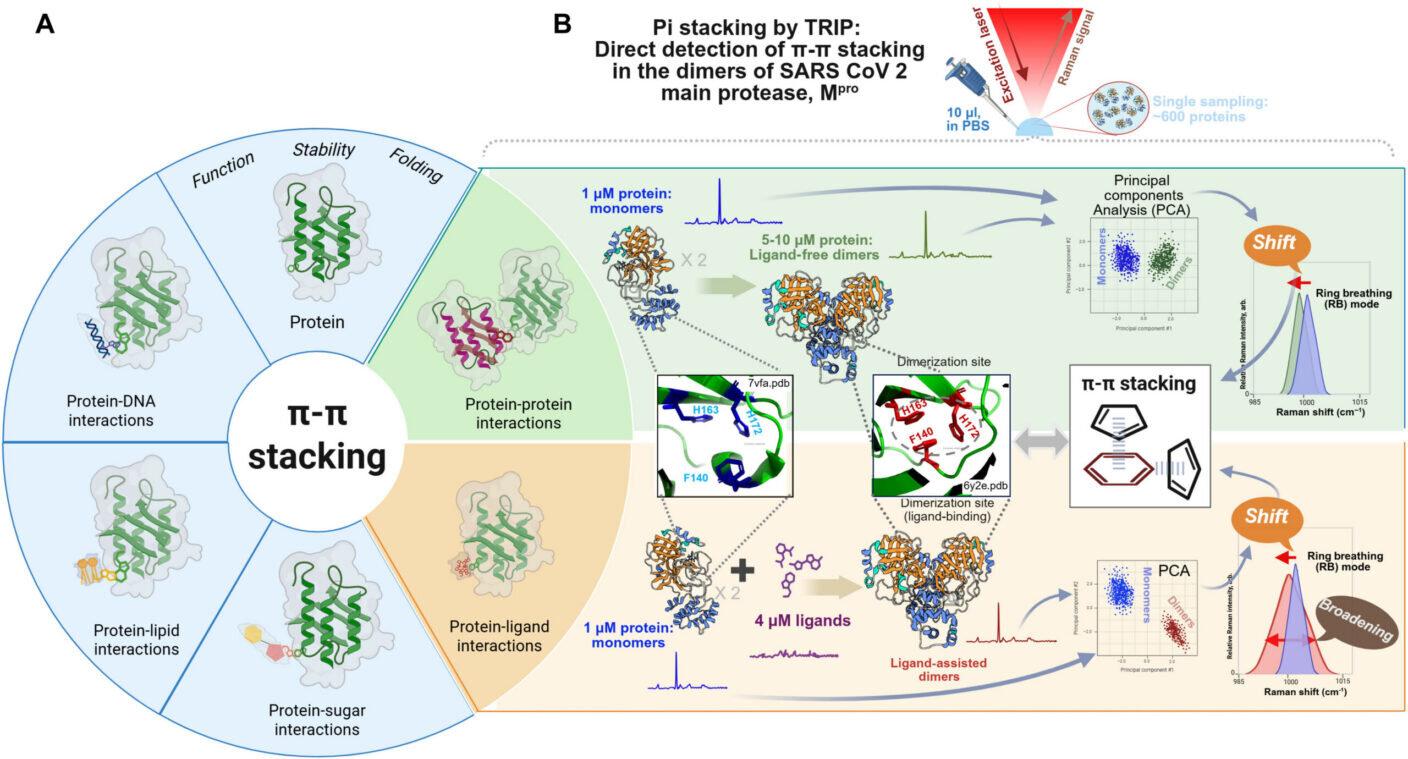
To directly measure pi-pi stacking, the team invented TRIP, a Raman-based approach that fires a laser onto a sample and records the unique vibrational signals that return. In essence, listening to the melody that bounces back from excited chemical bonds.
Every chemical bond vibrates at its own distinct frequency.
In this case, the team discovered that one signature—the "benzene ring breathing" vibration of the amino acid phenylalanine—acts like a sensitive reporter of pi-pi stacking.
When ring-shaped molecules move closer together and stack, their vibration shifts, like a musician drifting slightly off key. TRIP captures those tiny frequency shifts and translates them into a direct readout of pi-pi stacking.
"It's a classical technique used to capture quantum effects," Altangerel said. "We turned molecular vibrations into a readable signal. It's like listening to the music of a molecule and hearing how its internal forces change in real time."
After all, a new scientific technique is only as useful as its tests. For the team, that test came in the form of a familiar target: SARS-CoV-2, the virus responsible for the COVID-19 pandemic. Specifically, the researchers focused on its main protease, Mpro, a protein that holds the pathogen's structure and helps it reproduce.
"We selected coronavirus as our testing model because of its biological and clinical relevance," Altangerel said.
Mpro is especially useful for studying pi-pi stacking because it can function only as a "dimer." That is, it becomes active only when two copies bind together, and with that, the pi-pi stacking starts. So, as Mpro shifts between active and inactive states, the researchers picked up on corresponding changes to its vibrational signature in real time.
"I felt disbelief," Altangerel said. "These changes weren't random, they were systematic and they were direct indicators of vibrational shifts."
The team confirmed their findings using density functional theory, or DFT. "DFT is a quantum mechanical method that relies on using supercomputers to model and study phenomenon like pi-pi stacking," Hemmer said.
The calculations matched the direct measurements almost perfectly. "We were able to link and confirm our TRIP measurements to the DFT calculations," Altangerel said.
But the study didn't stop at initial experiments or computer models. The researchers took it to the next step by exposing the viral protein to several antiviral medications, using TRIP to track which was most effective and whether their findings would line up with the known antiviral potencies.
To their surprise, a clear pattern emerged: The stronger the antiviral medication, the stronger the vibrational signature became—a relationship that held up across several measurements.
"It was an exciting result," Altangerel said. "A quantum-scale interaction predicted real-world biological performance."
While further research and testing in the applications are needed, Altangerel and her team have already filed a U.S. patent for the invention, marking a major milestone in what could become a breakthrough technology for pharmaceutical development and discovery.
"Our work introduces more than just a new technique," Altangerel said. "Our aim is to transition it from technique to protocol, to aid in the acceleration and discovery of next-generation medications."
A laser, a virus and a supercomputer seem like they have little in common. Putting them together is the ingenuity of TRIP and the broader mission of Texas A&M's Institute for Quantum Science and Engineering.
Here, biologists work alongside quantum physicists, chemists with applied physicists, engineers with industry and government partners, each bringing a different perspective to the same challenge.
The Texas A&M University Institute for Quantum Science and Engineering brings together experts to tackle fundamental questions spanning quantum science, relativity and biophotonics.
"Our collaborations and partnerships are very important," Altangerel said. "Without the insight and support of everyone involved, this kind of work would not be possible."
By translating the internal melody of a protein into a measurable signal, Altangerel and her team have turned the quietest quantum whispers into a blueprint for cures and a source of promising innovation.
Narangerel Altangerel et al, From vibrations to function: Spectroscopic detection and quantification of π-π stacking in drug-responsive protein complexes, Science Advances (2026). DOI: 10.1126/sciadv.aeb3917
BA art history, MA material culture. Former museum editor, paramedic, and transplant coordinator. Editing for Science X since 2021. Full profile →
Master's in physics with research experience. Long-time science news enthusiast. Plays key role in Science X's editorial success. Full profile →
Thursday, June 25, 2026