The Universe as a lens for finding meaning at home
STARMUS is a festival like no other. Its co-founders astrophysicist Garik Israelian and Queen guitarist Brian May reflect on their path across the cosmos and back to Earth.
Nature
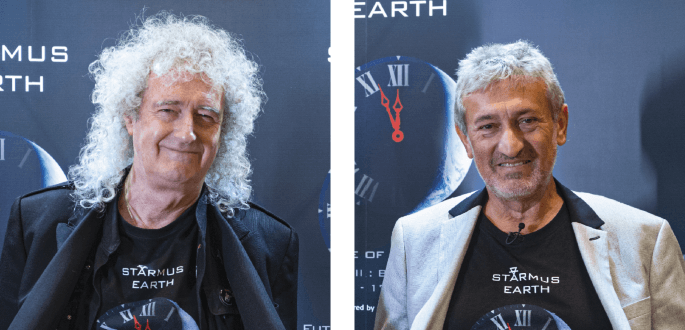
STARMUS is a festival like no other. Its co-founders astrophysicist Garik Israelian and Queen guitarist Brian May reflect on their path across the cosmos and back to Earth.
You have full access to this article via your institution.
Launching a cultural festival is not for the faint-hearted: in 2024 alone, 173 global music festivals were cancelled, and 64% failed to turn a profit despite some of them selling out. Now imagine starting a combined music and science festival. That is precisely what astrophysicists Garik Israelian and Brian May dreamed up back in 2011. With a nod to the 50th anniversary of the flight of Yuri Gagarin, they invited Apollo astronauts Neil Armstrong, Buzz Aldrin, Jim Lovell, Bill Anders and Charlie Duke, as well as Soviet era cosmonauts Alexei Leonov and Victor Gorbatko. They all showed up. Along with Nobel laureates and other scientific pioneers and thinkers.
Fifteen years later, the co-founders are planning STARMUS VIII with a return to Tenerife and the launch of a new award, the Jane Goodall Earth Medal, to acknowledge those working towards a better world for people, animals and the environment. It will be awarded alongside the Stephen Hawking Medal for science communication, created ten years ago; award winners have included Christopher Nolan, Brian Eno and Hans Zimmer. Israelian and May revisit the early days of STARMUS and share their ambitious plans in an uncertain future.
Brian May: Yes. I’ve always seen science and art as being different facets of the same thing. The best science is done with insights from art and the best art is informed by a sense of knowledge of the Universe. But the mission is to make science and art accessible, to bring minds together to solve problems that can’t be solved in any other way.
Garik Israelian: Peter warned us from his own experience with the WOMAD festival (World of Music, Arts and Dance). At the beginning it failed financially. It was a disaster for him, and he had to go on tour with his former band, Genesis, to get the money back.
So he was sceptical, and others were sceptical too. People were saying you either have a science festival or you have a music festival — you can’t mix those things. Especially if you want to push the level very high with Nobel laureates, astronauts, and at the same time be very ambitious musically.
GI: The first festival was a complete financial collapse. We lost all the money we invested. There were no sponsors, and we sold only around 60 tickets, with the other 140 or so participants from my institute and the university. People had not believed that Neil Armstrong, Jim Lovell and the others were really coming. They thought it was a joke. Then when they actually came, the public and the politicians were shocked.
The festival itself was a huge success — amazing, mind-blowing — but financially it crashed. We needed about two years to digest that and to recover before the next one.
GI: The first festival was focused mainly on space and astronomy, because it was dedicated to the 50-year anniversary of Yuri Gagarin’s flight. Russian cosmonauts made public statements saying that STARMUS did a better tribute to Gagarin than the entire Russian state. Many Apollo astronauts refused invitations from the Kremlin, but they all came to STARMUS, which was completely unknown.
Neil Armstrong explained that they came because STARMUS was not backed by companies like Coca-Cola, there were no commercial sponsors and no politics behind it. They saw it was a scientific festival.
It was very moving to see the hugs between cosmonauts and astronauts. The politics was at government level. Between them, it was purely about space.
GI: At the second festival. The government invested a few hundred thousand euros, and according to government and PR agencies, the impact was €171 million. That made headlines in Spain. The total budget of the whole festival was under one million euros, but the impact was €171 million. Politicians started asking how this was possible.
BM: I think all we can do is influence public education and opinion, and the public will pressure leaders to be sensible in their policies.
Trying to influence politicians directly is something I do all the time when lobbying on behalf of wild animals, and it’s very difficult. Many of those people are not trained for the jobs that they’re in, and there are deeply entrenched policies and vested interests.
So it comes back to educating the public — particularly young people — enabling them to sift through information so they can discriminate between what’s true and what isn’t.
GI: After the first festival, Stephen Hawking heard about us through Kip Thorne, who attended. So when Brian invited Stephen to see We Will Rock You in London, Stephen accepted straightaway. And then when STARMUS came up after the show, Stephen said he would be happy to come to the next festival.
When we announced Stephen Hawking as keynote speaker, people couldn’t believe it — first Neil Armstrong, now Stephen Hawking. Stephen gave amazing lectures and agreed to join the Advisory Board. I spent a lot of time with him during repeated visits to Tenerife. That experience convinced me to dedicate the next festival to him.
GI: Yes. That festival was a big explosion — many Nobel laureates, scientists and musicians. After that, STARMUS really kicked off. We went to Norway and then Switzerland, and started growing internationally.
Brian and I also became more convinced that we had to dedicate more time to Earth — to global problems, climate change and so on.
GI: We awarded the STARMUS Hawking Medal for Science Communication to Jane Goodall in 2022 and invited her to join the Advisory Board. Once Jane was on board, we were 100% convinced that we had to do something about Earth. That direction was reinforced when we awarded the next Stephen Hawking Medal to David Attenborough — one the greatest voices for life on this planet.
Her presence really changed our thinking. If we already know how to bring arts and science together, then we should apply that to bring more attention to global problems. That led to Earth-focused festivals and to creating the Jane Goodall Medal alongside the Hawking Medal — to recognize work on biodiversity, oceans, animal protection and human values.
BM: Well, in a sense, all of that is what’s next. It’s a new path to tread — but in another sense, I’ve always been on that path. Even when I started working on STARMUS with Garik, my main devotion — in terms of how I spend my time — has been to represent wild animals. I’ve had the Save Me Trust for many years now, and that’s our priority when we’re lobbying government, when we’re speaking to the public, and when we’re actually saving animals on the ground.
So this emphasis on animals and the environment isn’t new to me. But Jane was able to open that door — to move the emphasis of STARMUS more clearly towards animals and the environment. And I’m very happy about that. That feels good to me.
GI: I believe all scientists have to spend a fraction of their time on science communication. You decide how — writing, public talks, education — but you must do something to bring science to society. In my case, I realized I had the capacity to do this. It takes time, but it’s worth it. Thousands of young people have told me they chose physics, biology or space science because of STARMUS.
At the same time, people with no scientific understanding try to influence decisions and narratives — in climate science and in other areas like AI. That’s why it’s so important to explain what science really is and how scientific truth is established.
BM: Science is under threat at the moment. Truth is under threat. And very shortly, perhaps even already, we will find it very difficult to know what the truth is. That is what has led to the next STARMUS theme: the search for truth. How do we identify what truth is? How do we find it? How do we speak of it? That is our next thing. And it is very much tied up with Jane, I feel, and this is the right moment for us to become complete human beings. It is not enough for us to be artists making music or art, or scientists discovering wonderful things. We have to be complete human beings, which means we have to care about all humans and non-humans, giving respect and dignity to every creature on Earth. That’s how we save the planet. We have to be very unselfish and we have to be very discerning as to what the truth is and how we speak our truth as we move towards the future.
GI: STARMUS has grown far beyond what we ever imagined. Over the years, the Stephen Hawking Medal has become an ‘Oscar’ for science communication, recognizing those who bring knowledge and inspiration to society at the highest level. Now with the launch of the Jane Goodall Earth Medal, we hope to build a second pillar focused on life on Earth, on nature and on responsibility.
But at the same time, we are entering a very complex moment. We live in a world where misinformation spreads easily, where pseudoscience can reach millions of people through powerful media tools and where it is becoming ever harder to distinguish truth from noise.
This is why STARMUS is not just a festival. It is a platform for defending science, for promoting critical thinking and for bringing together voices that can speak with authority and responsibility. We also understand that this cannot be done alone. If we want to protect science, truth and life on Earth, we need strong partners (institutions, media, educators) who are willing to engage seriously in this effort. We hope that STARMUS can help lead this movement, but also that others will join us in shaping a future where knowledge, truth and responsibility still matter.
Nature Reviews Physics https://www.nature.com/natrevphys/
Chiao, M. The Universe as a lens for finding meaning at home. Nat Astron (2026). https://doi.org/10.1038/s41550-026-02926-2
DOI: https://doi.org/10.1038/s41550-026-02926-2
Anyone you share the following link with will be able to read this content:
Sorry, a shareable link is not currently available for this article.
Provided by the Springer Nature SharedIt content-sharing initiative
Monday, June 29, 2026