Rice grown on the moon? Air-to-fertilizer technology helps rice grow in lunar soil simulant
Securing sustainable food supplies is a key challenge for long-term human exploration and potential habitation of the moon. The moon's soil contains no organic material, and essential plant nitrogen sources like ammonia and nitrate are virtually nonexistent.
Phys.org
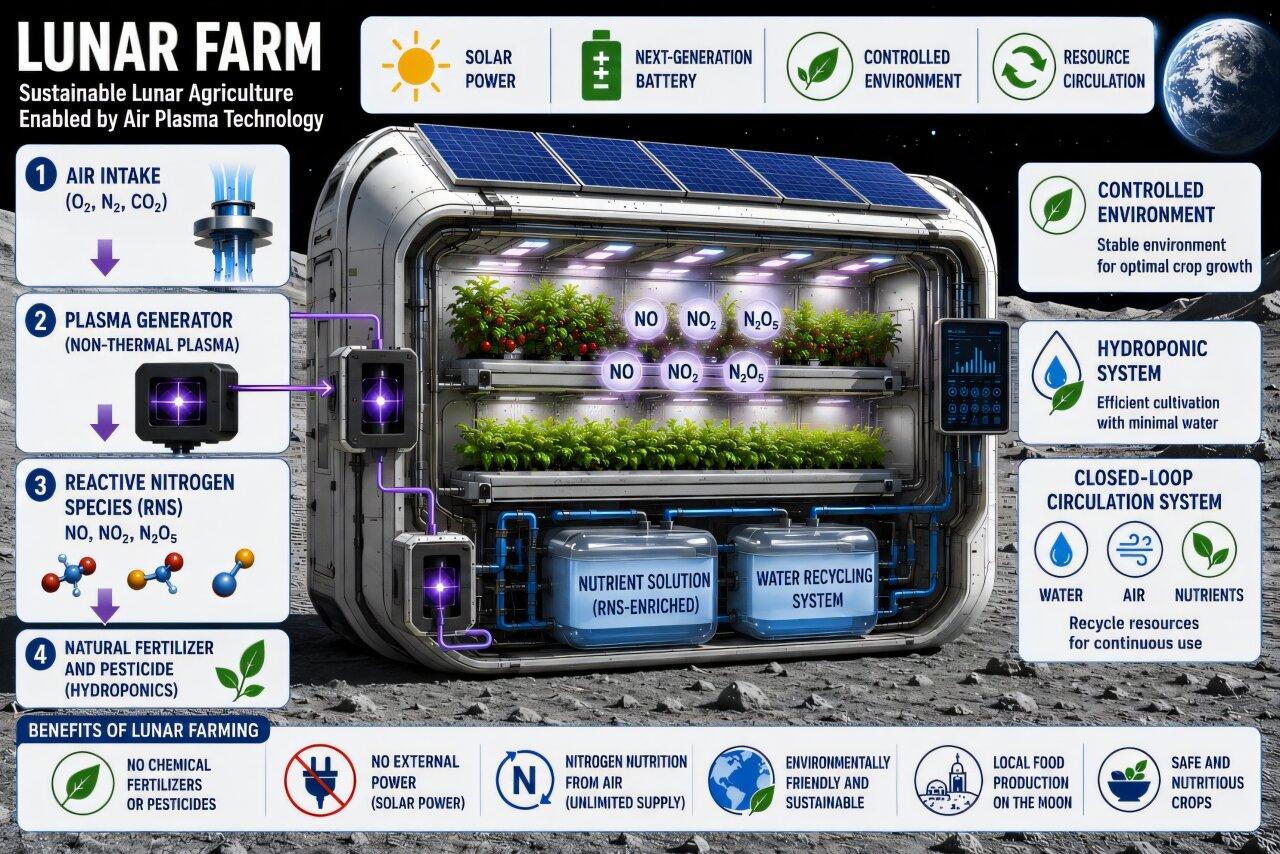
Securing sustainable food supplies is a key challenge for long-term human exploration and potential habitation of the moon. The moon's soil contains no organic material, and essential plant nitrogen sources like ammonia and nitrate are virtually nonexistent.
Researchers from Tohoku University and the Japan Aerospace Exploration Agency (JAXA) addressed this obstacle by creating a green, energy-efficient plasma technology capable of synthesizing nitrogen fertilizer from atmospheric air. The study was published in the journal npj Microgravity.
"Our portable plasma device selectively synthesizes dinitrogen pentoxide (N₂O₅) gas from atmospheric air, consuming less than 100 W in the process," says Toshiro Kaneko, a professor from the Graduate School of Engineering at Tohoku University and co-author of the study. "This plasma-produced gas promptly dissolves in water to generate nitrate (NO₃⁻) with an exceptionally high dissolution efficiency of nearly 100%."
Kaneko and his colleagues subsequently evaluated whether the N₂O₅-dissolved water could serve as a local nitrogen fertilizer for cultivating rice seedlings within a lunar regolith simulant.
Experiments revealed that adding N₂O₅-dissolved water to the lunar regolith simulant successfully neutralized the highly alkaline conditions, lowering its pH from 9.09 to an optimal 6.76. This neutralization released critical mineral nutrients trapped in the regolith, such as calcium, magnesium and potassium ions, allowing plants to absorb them more readily.
Concurrently, the elution of toxic aluminum ions (Al³⁺)—which normally hinder plant root development—was successfully suppressed. The release of critical minerals and suppression of harmful ones improved rice growth, especially compared with rice grown using pure water alone.
Beyond acting as a powerful nitrogen fertilizer, the researchers also discovered that the gas helps strengthen plants' immune systems and control unwanted traits. Spraying N₂O₅ gas directly onto plant leaves activates critical plant hormone pathways that boost resistance and immunity.
Gas exposure also suppressed stem and internode elongation, which prevents legginess, something essential for managing crop structures under the low-gravity conditions of space environments.
Kaneko stresses that while the technology is ideally suited for lunar farms, it can also help reduce environmental burdens in agriculture here on Earth.
"The process of producing this fertilizer operates entirely on electricity and low power, completely decoupling nitrogen fixation from fossil fuels, making the technology suitable for sustainable crop production on the moon and here on Earth."
Toshiro Kaneko et al, Plasma nitrogen fixation for future lunar agriculture, npj Microgravity (2026). DOI: 10.1038/s41526-026-00602-3
BSc Life Sciences & Ecology. Microbiology lab background with pharmaceutical news experience in oil, gas, and renewable industries. Full profile →
Bachelor's in mathematical biology, Master's in creative writing. Well-traveled with unique perspectives on science and language. Full profile →
Tuesday, June 30, 2026