Intracellular mechanisms promote tumor survival during hypoxia
Northwestern Medicine scientists have, for the first time, described the underlying mechanisms that regulate how cells rapidly change gene expression in response to hypoxia, a key feature of many treatment-resistant tumors, according to a recent study published in Science Advances.
Medical Xpress
by Melissa Rohman, Northwestern University
edited by Lisa Lock, reviewed by Robert Egan
This article has been reviewed according to Science X's editorial process and policies. Editors have highlighted the following attributes while ensuring the content's credibility:
Northwestern Medicine scientists have, for the first time, described the underlying mechanisms that regulate how cells rapidly change gene expression in response to hypoxia, a key feature of many treatment-resistant tumors, according to a recent study published in Science Advances.
Ali Shilatifard, Ph.D., the chair and Robert Francis Furchgott Professor of Biochemistry and Molecular Genetics, was the senior author of the study.
The P-TEFb transcriptional kinase complex regulates the pause-release checkpoint step in transcription by RNA polymerase II, a multiprotein complex that transcribes DNA into precursors of mRNA as well as most small nuclear RNA (snRNA) and microRNA.
P-TEFb is also essential for gene expression during hypoxia, a period of low oxygen within solid tumor microenvironments, and it reduces the effectiveness of chemotherapy, radiation therapy and immunotherapy. How these cancer cells rapidly shift gene expression in response to hypoxia has remained unclear, according to the authors.
"We wanted to understand how cells activate hypoxia-responsive genes beyond the well-known HIF pathway. Since P-TEFb is essential for hypoxic gene expression, we used an unbiased proteomics approach to identify proteins that interact with P-TEFb specifically during hypoxia," said Shimaa Soliman, Ph.D., a former postdoctoral research fellow in the Shilatifard laboratory and lead author of the study.
In the study, the scientists used a combination of proteomics, genetics and genomics approaches to better characterize the P-TEFb pathway.
First, they compared proteins associated with the transcriptional regulator P-TEFb under normal and low-oxygen conditions using immunoprecipitation and mass spectrometry. Next, they used CRISPR gene editing and RNA interference to remove or reduce these proteins and determine their functional importance. Finally, they used genome-wide chromatin profiling (ChIP-seq) to measure how these factors affect the recruitment of RNA polymerase II and the activation of hypoxia-responsive genes.
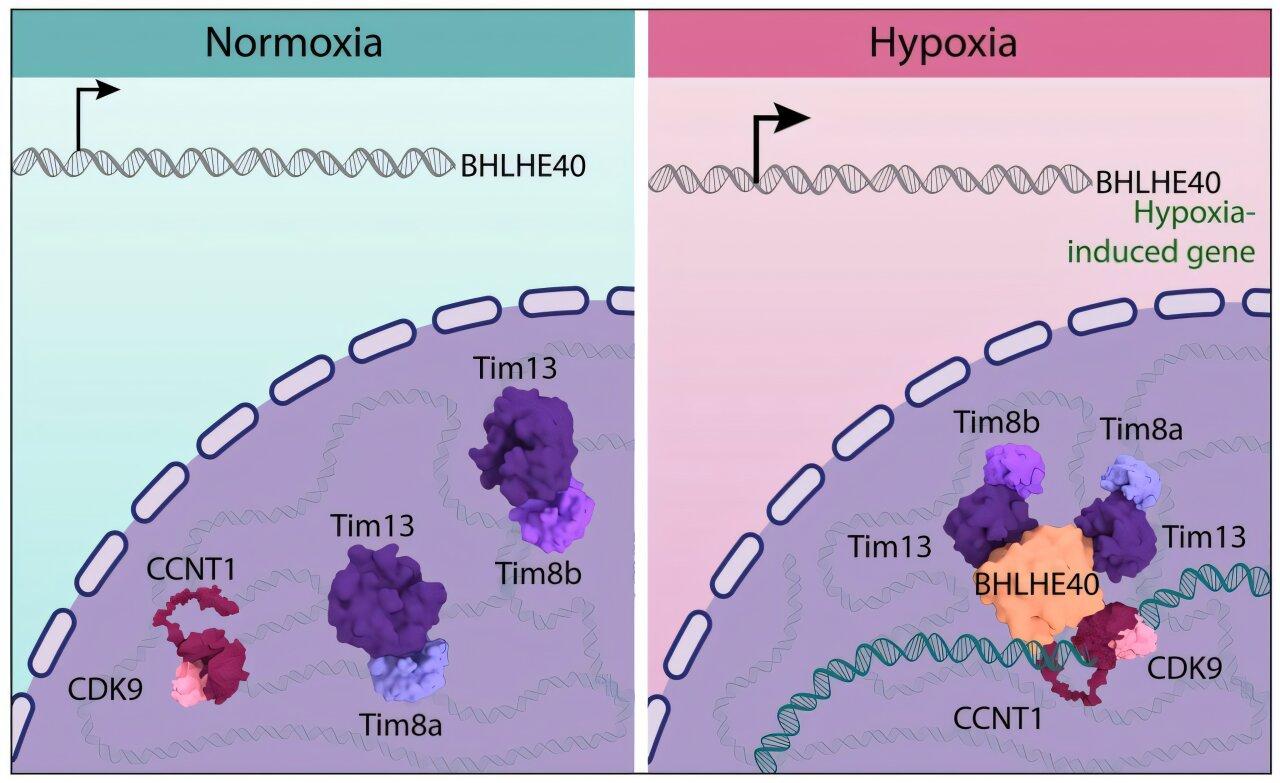
Using these approaches, they found that Tim8-Tim13 proteins are present in the nucleus and help regulate hypoxic gene expression.
They also discovered that the DNA-binding transcription factor BHLHE40 acts as a bridge between Tim8-Tim13 complexes and P-TEFb, creating a novel regulatory pathway that supports the hypoxic transcriptional response.
Together, the findings identify a new regulatory axis in which Tim8-Tim13 complexes and BHLHE40 modulate P-TEFb activity in the transcriptional response to hypoxia, which could help inform future treatment opportunities for patients who respond poorly to HIF-targeted treatments, Soliman said.
"Our work expands that framework by identifying a previously unrecognized regulatory axis involving P-TEFb, BHLHE40 and Tim8-Tim13 complexes. Importantly, this mechanism functions partially independently of HIF. From a therapeutic perspective, this is particularly relevant for cancers such as clear cell renal cell carcinoma, where hypoxia signaling is chronically activated," Soliman said.
Building on these findings, Soliman said her team seeks to better understand how Tim8-Tim13 complexes function in the nucleus, define how they regulate transcription and determine whether disrupting the BHLHE40-Tim8/Tim13-P-TEFb interaction could be therapeutically beneficial in hypoxia-driven cancers.
"This work uncovers an unexpected link between mitochondria and gene regulation in the nucleus, highlighting new layers of complexity in how cells sense and respond to low oxygen," Soliman said.
Shimaa Hassan AbdelAziz Soliman et al, Hypoxia-responsive interaction between P-TEFb, BHLHE40, and Tim8-Tim13 regulates hypoxic gene transcription, Science Advances (2026). DOI: 10.1126/sciadv.adz9295
BA art history, MA material culture. Former museum editor, paramedic, and transplant coordinator. Editing for Science X since 2021. Full profile →
Bachelor's in mathematical biology, Master's in creative writing. Well-traveled with unique perspectives on science and language. Full profile →
Saturday, June 27, 2026