An assay to quantify sexual commitment and stage conversion in the human malaria parasite Plasmodium falciparum
Sexual commitment and stage conversion are two crucial steps in the blood stage cycle of the human malaria parasite, as they mark its initial decision and subsequent differentiation in preparation for transmission to the mosquito vector. Here we present a Protocol Update that allows tracking and quantification of sexual commitment (in the asexual replicative parent, schizont stage) and conversion (in the nonreplicative sexual progeny, gametocyte stage) rates in the human malaria parasite Plasmodium falciparum. For this purpose, we combine three critical tools we recently established and validated. First, we use a standardized minimal medium to efficiently and reproducibly increase sexual commitment. Second, we use Tubulin Tracker Deep Red to label developing gametocytes and quantify the sexual conversion rate in reporter and reporter-free lines. Third, we use a fluorescent transgenic reporter line for consecutive quantification of sexual commitment and stage conversion in the same experimental procedure. These tools enable multiple experimental readouts including flow cytometry, fixed and live cell microscopy (including high content imaging) and other applications such as fluorescence-activated cell sorting. We anticipate that the presented sexual commitment–conversion assay will enable novel screening approaches for the identification of transmission blocking antimalarials and critical knowledge gaps in the Plasmodium transmission cycle to be closed. The Protocol can be completed in 7 d from start to finish. This Protocol Update uses new transgenic reporter parasite lines and synchronized gametocyte production by shifting cultures to a defined medium. Tubulin Tracker Deep Red in combination with the reporter line enables the quantification of both sexual commitment and conversion in the same experiment.
Nature
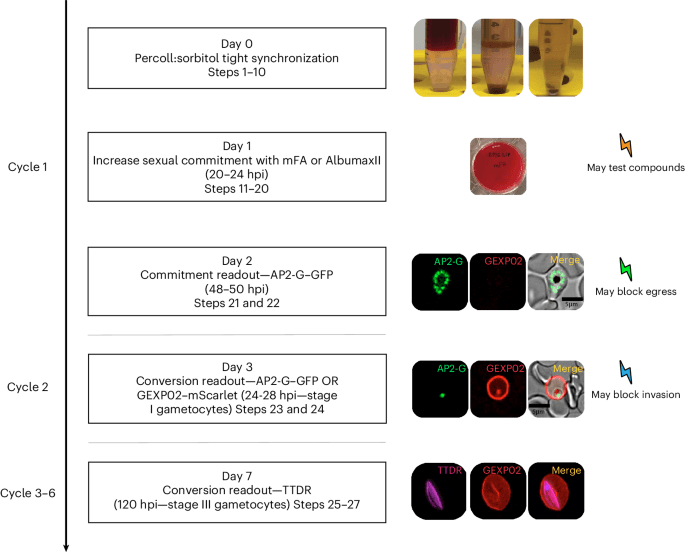
Sexual commitment and stage conversion are two crucial steps in the blood stage cycle of the human malaria parasite, as they mark its initial decision and subsequent differentiation in preparation for transmission to the mosquito vector. Here we present a Protocol Update that allows tracking and quantification of sexual commitment (in the asexual replicative parent, schizont stage) and conversion (in the nonreplicative sexual progeny, gametocyte stage) rates in the human malaria parasite Plasmodium falciparum. For this purpose, we combine three critical tools we recently established and validated. First, we use a standardized minimal medium to efficiently and reproducibly increase sexual commitment. Second, we use Tubulin Tracker Deep Red to label developing gametocytes and quantify the sexual conversion rate in reporter and reporter-free lines. Third, we use a fluorescent transgenic reporter line for consecutive quantification of sexual commitment and stage conversion in the same experimental procedure. These tools enable multiple experimental readouts including flow cytometry, fixed and live cell microscopy (including high content imaging) and other applications such as fluorescence-activated cell sorting. We anticipate that the presented sexual commitment–conversion assay will enable novel screening approaches for the identification of transmission blocking antimalarials and critical knowledge gaps in the Plasmodium transmission cycle to be closed. The Protocol can be completed in 7 d from start to finish.
In the original protocol published in 2015, a transgenic reporter parasite line was used. Gametocyte production was increased by shifting parasite cultures to a spent ‘conditioned’ medium. In this Protocol Update, we use newly developed transgenic reporter parasite lines and gametocyte production is increased via nutrient depletion by shifting the parasite cultures to a defined minimal fatty acid medium.
We have established the use of Tubulin Tracker Deep Red in combination with the reporter line as versatile tools for quantification of both sexual commitment and conversion in the same experimental setup.
This is a preview of subscription content, access via your institution
Prices may be subject to local taxes which are calculated during checkout
All data shown in figures were generated or analyzed for this Protocol, and source data are included as Supplementary information. Source data are provided with this paper.
Hawking, F., Wilson, M. E. & Gammage, K. Evidence for cyclic development and short-lived maturity in the gametocytes of Plasmodium falciparum. Trans. R. Soc. Trop. Med. Hyg. 65, 549–559 (1971).
Smalley, M. E. Plasmodium falciparum gametocytogenesis in vitro. Nature 264, 271–272 (1976).
Carter, R. & Miller, L. H. Evidence for environmental modulation of gametocytogenesis in Plasmodium falciparum in continuous culture. Bull. World Health Organ. 57, 37–52 (1979).
Ifediba, T. & Vanderberg, J. P. Complete in vitro maturation of Plasmodium falciparum gametocytes. Nature 294, 364–366 (1981).
Williams, J. L. Stimulation of Plasmodium falciparum gametocytogenesis by conditioned medium from parasite cultures. Am. J. Trop. Med. Hyg. 60, 7–13 (1999).
Dyer, M. & Day, K. P. Regulation of the rate of asexual growth and commitment to sexual development by diffusible factors from in vitro cultures of Plasmodium falciparum. Am. J. Trop. Med. Hyg. 68, 403–409 (2003).
Saliba, K. S. & Jacobs-Lorena, M. Production of Plasmodium falciparum gametocytes in vitro. Methods Mol. Biol. 923, 17–25 (2013).
Article CAS PubMed PubMed Central Google Scholar
Fivelman, Q. L. et al. Improved synchronous production of Plasmodium falciparum gametocytes in vitro. Mol. Biochem. Parasitol. 154, 119–123 (2007).
Buchholz, K. et al. A high-throughput screen targeting malaria transmission stages opens new avenues for drug development. J. Infect. Dis. 203, 1445–1453 (2011).
Article PubMed PubMed Central Google Scholar
Aingaran, M. et al. Host cell deformability is linked to transmission in the human malaria parasite Plasmodium falciparum. Cell. Microbiol. 14, 983–993 (2012).
Article CAS PubMed PubMed Central Google Scholar
Spielmann, T., Fergusen, D. J. & Beck, H.-P. etramps, a new Plasmodium falciparum gene family coding for developmentally regulated and highly charged membrane proteins located at the parasite-host cell interface. Mol. Biol. Cell 14, 1529–1544 (2003).
Article CAS PubMed PubMed Central Google Scholar
Mackellar, D. C. et al. Plasmodium falciparum PF10_0164 (ETRAMP10.3) is an essential parasitophorous vacuole and exported protein in blood stages. Eukaryot. Cell 9, 784–794 (2010).
Article CAS PubMed PubMed Central Google Scholar
Lopez-Barragan, M. J. et al. Directional gene expression and antisense transcripts in sexual and asexual stages of Plasmodium falciparum. BMC Genomics 12, 587 (2011).
Article CAS PubMed PubMed Central Google Scholar
da Cruz, F. P. et al. Drug screen targeted at Plasmodium liver stages identifies a potent multistage antimalarial drug. J. Infect. Dis. 205, 1278–1286 (2012).
Article PubMed PubMed Central Google Scholar
Hanson, K. K. et al. Torins are potent antimalarials that block replenishment of Plasmodium liver stage parasitophorous vacuole membrane proteins. Proc. Natl Acad. Sci. USA 110, E2838–E2847 (2013).
Article CAS PubMed PubMed Central Google Scholar
Brancucci, N. M., Goldowitz, I., Buchholz, K., Werling, K. & Marti, M. An assay to probe Plasmodium falciparum growth, transmission stage formation and early gametocyte development. Nat. Protoc. 10, 1131–1142 (2015).
Article CAS PubMed PubMed Central Google Scholar
Alam, M. M. et al. Validation of the protein kinase PfCLK3 as a multistage cross-species malarial drug target. Science 365, eaau1682 (2019).
Kato, N. et al. Diversity-oriented synthesis yields novel multistage antimalarial inhibitors. Nature 538, 344–349 (2016).
Article CAS PubMed PubMed Central Google Scholar
Brancucci, N. M. B. et al. Lysophosphatidylcholine regulates sexual stage differentiation in the human malaria parasite Plasmodium falciparum. Cell 171, 1532–1544.e15 (2017).
Article CAS PubMed PubMed Central Google Scholar
Thommen, B. T. et al. Revisiting the effect of pharmaceuticals on transmission stage formation in the malaria parasite Plasmodium falciparum. Front. Cell. Infect. Microbiol. 12, 802341 (2022).
Article CAS PubMed PubMed Central Google Scholar
Watzlowik, M. T. et al. Plasmodium blood stage development requires the chromatin remodeller Snf2L. Nature 639, 1069–1075 (2025).
Article CAS PubMed PubMed Central Google Scholar
Ngotho, P. et al. Reversible host cell surface remodelling limits immune recognition and maximizes survival of Plasmodium falciparum gametocytes. PLoS Pathog. 21, e1013110 (2025).
Article CAS PubMed PubMed Central Google Scholar
Portugaliza, H. P., Llora-Batlle, O., Rosanas-Urgell, A. & Cortes, A. Reporter lines based on the gexp02 promoter enable early quantification of sexual conversion rates in the malaria parasite Plasmodium falciparum. Sci. Rep. 9, 14595 (2019).
Article PubMed PubMed Central Google Scholar
Filarsky, M. et al. GDV1 induces sexual commitment of malaria parasites by antagonizing HP1-dependent gene silencing. Science 359, 1259–1263 (2018).
Article CAS PubMed PubMed Central Google Scholar
Dearnley, M. et al. Reversible host cell remodeling underpins deformability changes in malaria parasite sexual blood stages. Proc. Natl Acad. Sci. USA 113, 4800–4805 (2016).
Article CAS PubMed PubMed Central Google Scholar
Ghorbal, M. et al. Genome editing in the human malaria parasite Plasmodium falciparum using the CRISPR–Cas9 system. Nat. Biotechnol. 32, 819–821 (2014).
Zanghí, G. et al. Genome-wide gene expression profiles throughout human malaria parasite liver stage development in humanized mice. Nat. Microbiol. 10, 569–584 (2025).
Article PubMed PubMed Central Google Scholar
Venugopal, K. et al. Defining the proteome of sexually committed parasites in Plasmodium falciparum. Mol. Cell. Proteomics 25, 101505 (2026).
Pelle, K. G. et al. Transcriptional profiling defines dynamics of parasite tissue sequestration during malaria infection. Genome Med. 7, 19 (2015).
Article PubMed PubMed Central Google Scholar
Llora-Batlle, O. et al. Conditional expression of PfAP2-G for controlled massive sexual conversion in Plasmodium falciparum. Sci. Adv. 6, eaaz5057 (2020).
Article CAS PubMed PubMed Central Google Scholar
Boltryk, S. D. et al. CRISPR/Cas9-engineered inducible gametocyte producer lines as a valuable tool for Plasmodium falciparum malaria transmission research. Nat. Commun. 12, 4806 (2021).
Article CAS PubMed PubMed Central Google Scholar
Zhang, J. H., Chung, T. D. & Oldenburg, K. R. A simple statistical parameter for use in evaluation and validation of high throughput screening assays. J. Biomol. Screen. 4, 67–73 (1999).
This work was supported by Swiss National Science Foundation grant no. 310030-207789 (M.M. and K.V.), European Research Council Consolidator award BoneMalar (M.M. and K.V.), Royal Society Wolfson Merit Award (M.M.), Wellcome Trust Center award 104111 (M.M. and K.V.), Swiss National Science Foundation grant no. 310030_200683 (N.M.B.B. and B.T.T.) and the Secretaría Nacional de Ciencia, Tecnología e Innovación (SENACYT) grant no. DDCCT 204-2023 (E.D.A.B. and L.C.).
Institute of Parasitology, Vetsuisse and Medical Faculties, University of Zurich, Zurich, Switzerland
Kannan Venugopal, Eveline D. A. Borbon & Matthias Marti
School of Infection and Immunity, University of Glasgow, Glasgow, UK
Institute of Scientific Research and High Technology Services of Panama (INDICASAT), Panama City, Panama
Swiss Tropical and Public Health Institute, Allschwil, Switzerland
Basil T. Thommen & Nicolas M. B. Brancucci
K.V.: conceptualization, data curation, methodology, investigation and writing—original draft and editing. E.D.A.B.: investigation. B.T.T.: investigation and writing—review and editing. N.M.B.B.: supervision and writing—review and editing. L.C.: supervision and funding acquisition. M.M.: conceptualization, supervision, funding acquisition and writing—original draft and editing.
Correspondence to Kannan Venugopal or Matthias Marti.
The authors declare no competing interests.
Nature Protocols thanks Felix Müller, Gabriele Pradel and the other, anonymous, reviewer(s) for their contribution to the peer review of this work.
Venugopal, K. et al. Mol. Cell. Proteomics 25, 101505 (2026): https://doi.org/10.1016/j.mcpro.2025.101505
Watzlowik, M. T. et al. Nature 639, 1069–1075 (2025): https://doi.org/10.1038/s41586-025-08595-x
Brancucci, N. M. B. et al. Cell 171, 1532–1544.e15 (2017): https://doi.org/10.1016/j.cell.2017.10.020
This protocol is an update to Nat. Protoc. 10, 1131–1142 (2015): https://doi.org/10.1038/nprot.2015.072
Springer Nature or its licensor (e.g. a society or other partner) holds exclusive rights to this article under a publishing agreement with the author(s) or other rightsholder(s); author self-archiving of the accepted manuscript version of this article is solely governed by the terms of such publishing agreement and applicable law.
Venugopal, K., Borbon, E.D.A., Thommen, B.T. et al. An assay to quantify sexual commitment and stage conversion in the human malaria parasite Plasmodium falciparum. Nat Protoc (2026). https://doi.org/10.1038/s41596-026-01378-2
DOI: https://doi.org/10.1038/s41596-026-01378-2
Anyone you share the following link with will be able to read this content:
Sorry, a shareable link is not currently available for this article.
Provided by the Springer Nature SharedIt content-sharing initiative
Thursday, July 2, 2026