Quantum semiconductor design could expand search for dark matter
Dark matter accounts for 85% of the matter in the universe, but scientists still do not know what it is made of. A study, published in Physical Review Letters, by Rice University researchers proposes a detector design that could help search for axions, hypothetical particles that many physicists think could make up dark matter.
Phys.org
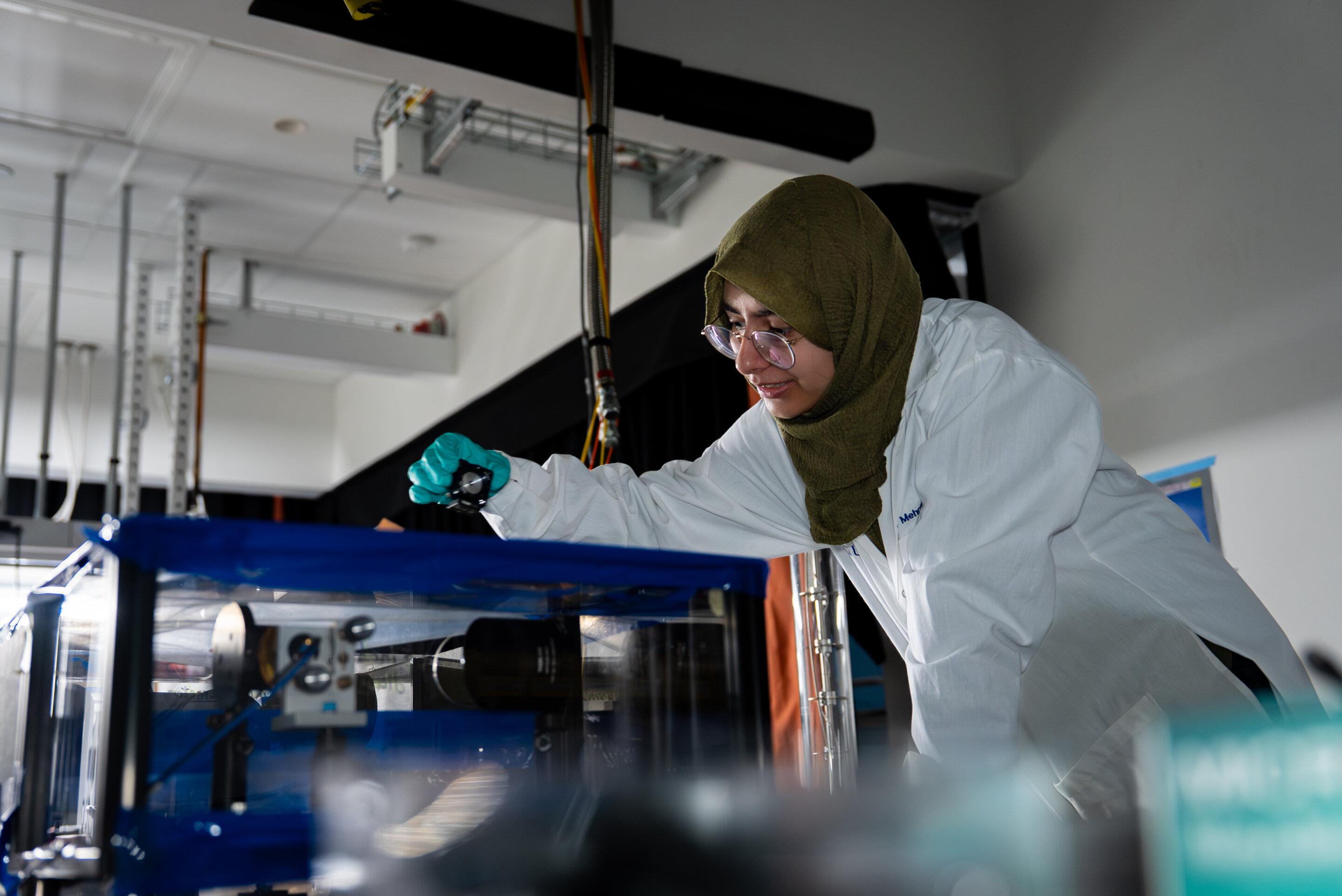
Dark matter accounts for 85% of the matter in the universe, but scientists still do not know what it is made of. A study, published in Physical Review Letters, by Rice University researchers proposes a detector design that could help search for axions, hypothetical particles that many physicists think could make up dark matter.
The proposed detector would rely on a class of semiconductor materials whose response changes when their orientation shifts within a magnetic field. This material response makes it easier to tune the detector, allowing researchers to probe a range of axion masses that have remained difficult to explore with existing technologies.
"We are proposing a well-studied material from condensed matter physics for a new application—axion detection," said Jaanita Mehrani, a doctoral student in Rice's Applied Physics Graduate Program who is the first author on the study. "What's different about this material is that it doesn't have to use complex mechanical tuning mechanisms, it simply tunes with the magnetic field."
Dark matter cannot be observed directly because it interacts very weakly with ordinary matter. Scientists infer its existence from its gravitational effects on galaxies and the evolution of the universe. However, theory predicts that axions can convert into particles of light, or photons, when exposed to a strong magnetic field.
The detector, called Semiconductor Quantum Well Axion Radiometer Experiment, or SQWARE, is designed to help axions convert into photons. To achieve this, SQWARE uses stacks of ultrathin semiconductor layers called multiple quantum wells, which trap electrons in flat, two-dimensional sheets.
When confined in this manner, the electrons behave like a plasma, changing how light moves through the material.
"What's happening is this plasma is giving the photons an effective mass, which helps the momentum conservation between the axion and the photon, since in a vacuum, axions have a mass but photons don't," Mehrani said. "We're trying to help that momentum mismatch and resonantly convert axions to photons, enhancing the photon signal so that we can more easily detect dark matter."
Although the study is theoretical, the researchers developed the design with practical constraints in mind. They evaluated whether the proposed semiconductor structures could be fabricated with existing or near-term technology and estimated how the detector would perform under realistic experimental conditions.
The next step is to determine whether the materials perform as expected in the laboratory. The team is now characterizing candidate semiconductor structures and developing prototype devices to test the concept experimentally.
"Advances in semiconductor materials have created opportunities well beyond their original applications," said Shengxi Huang, associate professor of electrical and computer engineering and materials science and nanoengineering at Rice and a co-corresponding author on the study.
"This work explores whether those same materials can be adapted to address one of the central questions in particle physics and cosmology."
Junichiro Kono, Rice's Karl F. Hasselmann Professor of Engineering, professor of electrical and computer engineering, physics and astronomy, and materials science and nanoengineering, and faculty director of the Smalley-Curl Institute, is also a co-corresponding author on the study.
Jaanita Mehrani et al, Quantum Semiconductor Heterostructures for meV Axion Dark Matter Detection, Physical Review Letters (2026). DOI: 10.1103/y7jl-gj2k
Journal information: Physical Review Letters
BSc Life Sciences & Ecology. Microbiology lab background with pharmaceutical news experience in oil, gas, and renewable industries. Full profile →
Bachelor's in mathematical biology, Master's in creative writing. Well-traveled with unique perspectives on science and language. Full profile →
Thursday, July 2, 2026