Analog gravity advance offers new insights into Hawking radiation from black holes
Hawking radiation is a form of radiation emitted by black holes, as theoretically predicted by Stephen Hawking. It suggests that black holes do not merely swallow matter—as had previously been assumed—but also emit very faint radiation themselves. This radiation has not yet been observed in space; instead, researchers use models in the laboratory that mimic the behavior of black holes.
Phys.org
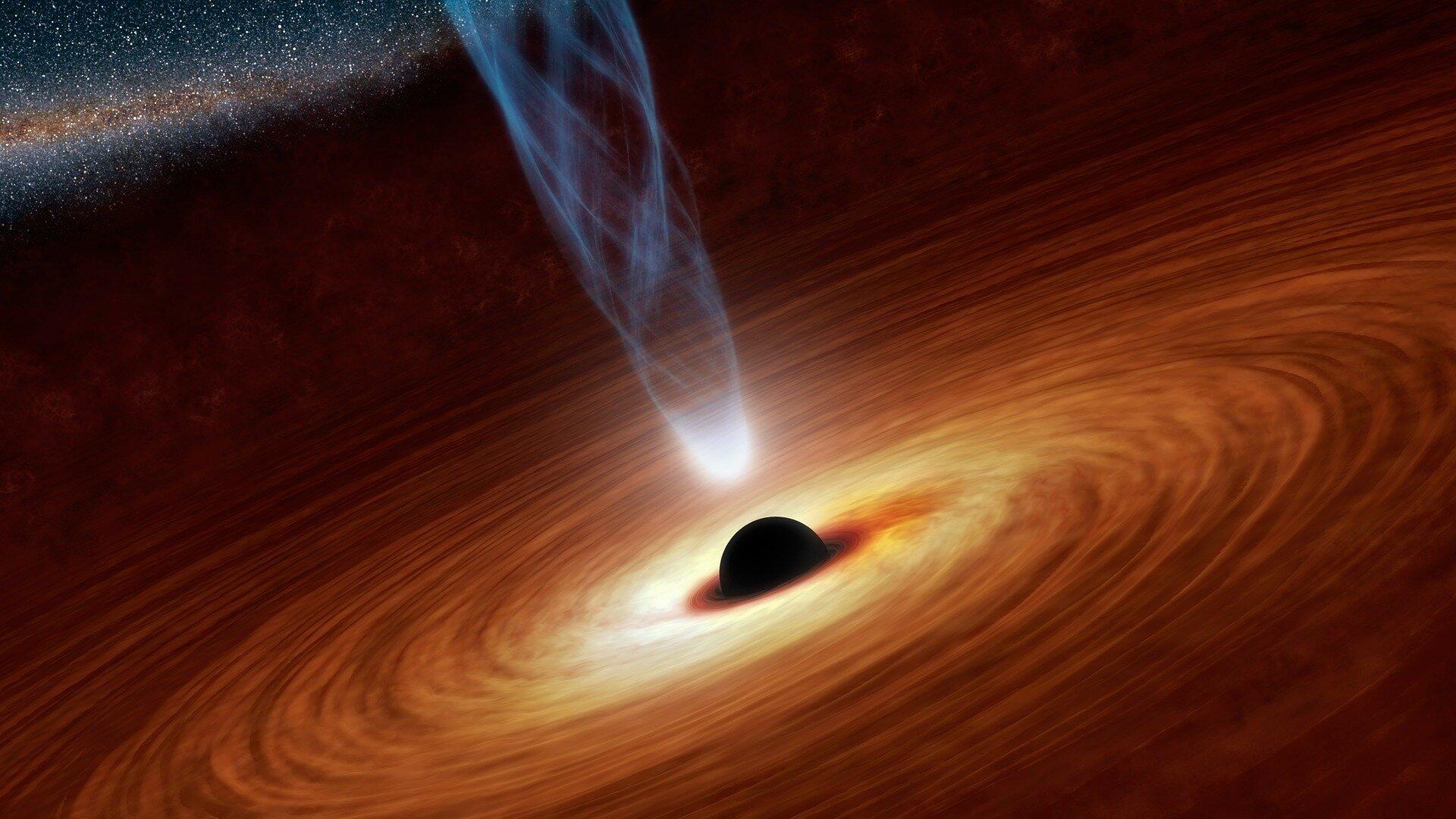
Hawking radiation is a form of radiation emitted by black holes, as theoretically predicted by Stephen Hawking. It suggests that black holes do not merely swallow matter—as had previously been assumed—but also emit very faint radiation themselves. This radiation has not yet been observed in space; instead, researchers use models in the laboratory that mimic the behavior of black holes.
Although the effect of Hawking radiation is well known in astrophysics, the mechanism by which it arises in a gravitational context has not yet been fully elucidated. A scientist from Paderborn University along with an international team of researchers from the Weizmann Institute of Science in Israel and Cinvestav in Mexico is now shedding light on this mechanism using gravitational analogs in the laboratory.
The team has theoretically modeled the process by which Hawking radiation is generated in a nonlinear optical environment, identifying a simple, direct mechanism in the process. Furthermore, the team was able to observe in experiments that the radiation affects the system. The results have now been published in Nature.
Traditional models describe a cascading mechanism in which various quantum mechanical processes interact to generate the radiation. Through a combination of rigorous theoretical modeling and precise experiments on a fiber-optic analog of the event horizon, the researchers discovered how Hawking radiation and its feedback on the system might arise. Instead of a complicated, multistage process, they found evidence of a simple, direct mechanism for radiation generation.
"This simplifies the theoretical understanding and opens up new ways of calculating effects in such systems. It might even shed light on how Hawking radiation arises in the context of gravity," explains Dr. Lorenzo M. Procopio. He was previously part of the research group at the Weizmann Institute of Science, where he led the project and carried out and analyzed the experiments. Procopio is now conducting research at the Institute for Photonic Quantum Systems (PhoQS) and the Department of Physics at Paderborn University.
The researchers not only demonstrated the more direct generation process, but also experimentally verified how Hawking radiation affects the system. This means the emitted Hawking radiation does not merely act passively from within the system, but actively interacts with it. This interaction is essential for understanding whether and how black holes remain in equilibrium, or how they lose their mass. Observing this feedback in a controlled laboratory setting gives scientists a unique opportunity to study effects that would be virtually inaccessible in the real universe because of the extreme scales involved.
The ability to study Hawking radiation in controlled environments could provide important clues to the nature of quantum gravity. Although black holes themselves remain out of reach, these analog experiments allow deep insights into the underlying physics.
Lorenzo M. Procopio et al, Backreaction of stimulated Hawking radiation in an optical analogue, Nature (2026). DOI: 10.1038/s41586-026-10720-3
BA art history, MA material culture. Former museum editor, paramedic, and transplant coordinator. Editing for Science X since 2021. Full profile →
Bachelor's in mathematical biology, Master's in creative writing. Well-traveled with unique perspectives on science and language. Full profile →
Thursday, July 2, 2026