West Asia war LIVE: Lebanon, Israel and U.S. sign trilateral framework pact
Follow The Hindu LIVE for the latest updates on the West Asia war, as the United States and Iran traded military strikes after Washington accused Tehran of attacking a cargo ship, jeopardising a fragile ceasefire.
The Hindu
The United States carried out further strikes on Iran on Sunday (June 28, 2026), said the U.S. Central Command, targeting various sites, including military surveillance infrastructure.
Lebanese President Joseph Aoun told U.S. President Donald Trump that he hoped Washington would help prevent violations of a framework agreement with Israel and ensure agreed commitments are fulfilled, particularly by pressing Israel to withdraw from occupied areas in southern Lebanon.
Earlier in the day, Israeli airstrikes on the southern Lebanese town of Nabatieh al-Fawqa killed at least one person and wounded two more, the health ministry said. This toll was announced shortly after Lebanon’s state news agency reported that Nabatieh al-Fawqa had been hit by drones and warplanes.
Also read: How Trump’s posts on Iran zigzagged during the war
Bahrain accused Iran on Saturday (June 27) of launching a new drone attack targeting the island nation. Iran accused the United States on Saturday (June 27, 2026) of violating their deal to end the war, after Washington launched strikes on Iranian territory and Tehran responded with attacks on U.S. targets in the Gulf.
The United States carried out further strikes on Iran, said the U.S. Central Command, targeting various sites, including military surveillance infrastructure.
“CENTCOM forces launched strikes today in direct response to continued Iranian aggression against commercial shipping,” CENTCOM said in a statement. “After yesterday’s U.S. strikes in response to the Iranian attack on M/V Ever Lovely, Iran was given a chance to honor the ceasefire agreement but elected not to when its forces launched a one-way attack drone that hit M/T Kiku this morning,” it said.
Lebanese President Joseph Aoun told U.S. President Donald Trump that he hoped Washington would help prevent violations of a framework agreement with Israel and ensure agreed commitments are fulfilled, particularly by pressing Israel to withdraw from occupied areas in southern Lebanon, the Lebanese presidency said on Saturday (June 27, 2026).
Mr. Aoun also told Mr. Trump in a phone call that Lebanon would assume its responsibilities in implementing the framework agreement, the presidency added in a statement.
France said on Saturday (June 27, 2026) that it was “ready to contribute” to the framework agreement signed the day before by Lebanon and Israel, adding it should pave the way for the full restoration of Lebanese sovereignty.
The agreement was signed in Washington after five rounds of talks, and it includes a process aimed at disarming Hezbollah.
But Hezbollah’s leader Naim Qassem has rejected the agreement, accusing the Lebanese government of surrendering sovereignty.
Israel’s far-right National Security Minister Itamar Ben Gvir denounced the U.S.-brokered agreement with Lebanon, saying the Lebanese government could not be trusted to disarm Hezbollah.
“The agreement with Lebanon is a big mistake... Indeed, we are staying in most of the territory for now, but the state of Lebanon will not disarm Hezbollah,” he said on his Telegram channel.
“Members of the Lebanese government are Hezbollah ministers, and Lebanon cannot be trusted to take Hezbollah’s weapons ... Only IDF soldiers will destroy Hezbollah, no other party will do it for us.”
Israeli Prime Minister Benjamin Netanyahu reiterated that Israeli forces would remain in the so-called security zone established by the military some 10 kilometres (six miles) inside the Lebanese territory.
“We will remain in the area until Hezbollah and the rest of the terror groups are disarmed,” he said.
“Both the United States and Lebanon have recognised Israel’s right to maintain a security zone inside Lebanon for as long as it remains necessary to safeguard our security.
“We will continue to hold this security zone until Hezbollah and all other terrorist organisations are fully disarmed and no longer pose any threat to Israel from Lebanese territory,” he said.
Israel’s Prime Minister Benjamin Netanyahu on Saturday (June 27, 2026) hailed the U.S.-brokered agreement with Lebanon, calling it a historic achievement that dealt a blow to arch-foes Iran and Hezbollah. “Yesterday ... we achieved a historic deal for the state of Israel after direct negotiations between Israel and Lebanon,” he said in a televised briefing. “This is a blow to Iran and Hezbollah.”
Israeli airstrikes on the southern Lebanese town of Nabatieh al-Fawqa killed at least one person and wounded two more, the health ministry said on Saturday (June 27, 2026).
The Ministry’s emergency operations centre gave the toll shortly after Lebanon’s state news agency reported that Nabatieh al-Fawqa had been hit by drones and warplanes.
Israeli Defence Minister vowed today to respond with “great force” if Iran attacked Israel in an attempt to prevent the implementation of an agreement with Lebanon aimed at securing peace between the two countries.
“If Iran tries to attack Israel to prevent the implementation of the agreement, we will act against it with great force,” Israel Katz said in a video statement, adding that the agreement with Lebanon had dealt a “strategic blow to the Iranian axis”.
Israel’s Defence Minister said that Israeli forces had been ordered to prepare for an extended stay in the so-called security zone in southern Lebanon, after Israel and Lebanon agreed on a framework to end hostilities.
“The prime minister and I have instructed the IDF to prepare for an extended stay in the security zone,” Israel Katz said in a video statement, referring to an area up to 10 km inside the Lebanese territory.
“The important principle established in the agreement is that there will be no redeployment by Israel in southern Lebanon, no withdrawal, as long as the terrorist organisation Hezbollah is not disarmed throughout Lebanon,” he said.
inflation in Iran rose sharply in June, driven by the war, reaching a peak of 88.6% year-on-year, according to official figues.
According to the Statistical Centre of Iran, during the Persian month of Khordad (May 22-June 21), food prices more than doubled year-on-year, in a country already long plagued by hyperinflation due to sanctions. Bread and grain prices rose by 138.8%, milk, cheese and eggs by 151.9%, while the prices of red meat and poultry skyrocketed by 178.2%.
By comparison, year-on-year inflation stood at 68% in February, prior to the outbreak of the war.
Iran accused the United States of violating their deal to end the West Asia war, after Washington launched strikes on Iranian territory and Tehran responded with attacks on U.S. targets in the Gulf.
Iran said “these brutal attacks... are a blatant violation” of the deal to end the war. Its Revolutionary Guards said they had struck U.S. sites in the Gulf region and that “if the aggression is repeated, our response will be broader”.
Hezbollah chief Naim Qassem said that the Israel-Lebanon framework agreement signed in Washington is “null”, a “humiliation” and a surrender of sovereignty, and should be replaced by the Iran-U.S. memorandum.
Qassem said in a statement that any attempt to link Israel’s withdrawal from southern Lebanon to the group’s disarmament crossed “red lines.”
An Israeli drone struck the Nabatiyeh area in southern Lebanon today, Lebanon’s state news agency said.
The reported strike came a day after Israel and Lebanon signed a U.S.-brokered security arrangement aimed at reducing tensions along their border following months of cross-border hostilities with Hezbollah.
The Israeli military said it carried out an airstrike targeting suspected militants in the Nabatiyeh area of southern Lebanon. An Israeli military spokeswoman told AFP that the strike targeted “suspected terrorists who posted a threat to IDF soldiers” in the Nabatiyeh area.
An oil tanker in the Strait of Hormuz was struck and damaged by an “unidentified projectile”, British maritime security agency UKMTO said today, following the first exchange of fire between the U.S. and Iran since their deal to end the West Asia war.
“The vessel sustained damage to their bridge; all crew are reported safe,” UKMTO said, while another British marine security firm, Vanguard Tech, said the vessel was the Panama-flagged tanker KIKU.
Iran said it struck targets linked to U.S. forces on Saturday (June 27, 2026) in response to U.S. airstrikes on its southern coast, as each side continued to accuse the other of violating last week’s agreement meant to end the four-month-old war.
Iran claims it targeted U.S.-linked sites in retaliation for airstrikes, as Bahrain reports an Iranian drone attack.
Bahrain’s foreign Ministry said on Saturday (June 27) that it had been targeted by several Iranian drones, accusing Tehran of sabotaging peace efforts after the United States and Iran traded strikes for the first time since signing an agreement to end the West Asia war.
The Ministry expressed Bahrain’s “strongest condemnation of the targeting of its territory at dawn this Saturday by several Iranian drones, in flagrant violation of its sovereignty”, saying Iran’s attacks were “sabotaging peace efforts”.
Bahrain accused Iran on Saturday (June 27) of launching a new drone attack targeting the island nation.
A statement from Bahrain’s Foreign Ministry said a “number of Iranian drones” targeted the country. It did not elaborate on the target.
Iran did not immediately acknowledge launching an attack.
Prime Minister Shehbaz Sharif on Saturday (June 27) said that Pakistan has emerged as a “peacemaker” in the world after its efforts for peace in West Asia culminated in the signing of an agreement between the U.S. and Iran.
The U.S. and Iran have agreed on a roadmap aimed at reaching a final agreement within 60 days after talks mediated by Qatar and Pakistan, held in Switzerland last week.
The high-level talks were held under the framework of the Islamabad Memorandum of Understanding (MoU), signed by the U.S. and Iran on June 18.
An explosive drone targeted a camp belonging to an Iranian Kurdish opposition group north of Iraq’s Erbil, security sources told Reuters on Saturday (June 27).
No casualties were reported as the camp had recently been evacuated, the security sources added.
Iran said it struck targets linked to U.S. forces in response to U.S. airstrikes on its southern coast, which it said violated the U.N. Charter and the war-ending memorandum between the two countries, according to a statement by its Foreign Ministry.
Iran did not identify the targets or say where they were located.
Israeli Prime Minister Benjamin Netanyahu said on Friday (June 27, 2026) that Israel would remain in south Lebanon until Hezbollah disarms, shortly after the announcement in Washington of a framework agreement with the United States and Lebanon.
Netanyahu states Israel will stay in southern Lebanon until Hezbollah disarms, following a new US-Lebanon framework agreement.
Washington on Friday released the text of a trilateral framework between Israel, Lebanon and the United States aimed at ending hostilities that have been a violent second front of the West Asia war.
The following are highlights of the 14-point agreement signed in the U.S. capital:
The U.S.-Israel-Lebanon agreement outlines disarmament plans and troop withdrawal for lasting peace and security in the region.
Iran launched attacks on U.S. sites in the Gulf in response to American strikes on the country, state media said on Saturday (June 27, 2026), after Washington accused Tehran of attacking one of its cargo ships in the Strait of Hormuz.
The trading of fire raised questions about efforts to keep the crucial waterway open while Washington and Tehran negotiate a final settlement to a war that began on February 28 with U.S. and Israeli strikes on Iran.
U.S. and Iran exchange strikes, escalating tensions while negotiating a truce in West Asia amid concerns over the Strait of Hormuz.
The UN’s nuclear chief said on Friday (June 26, 2026) that Iran’s pledge not to build a nuclear weapon would need “very strong” verification, as the United States and the Islamic Republic negotiate a permanent settlement to end their war. Iran’s nuclear programme is a key sticking point in talks to end the West Asia war, which began in late February with massive U.S.-Israeli strikes.
UN nuclear chief emphasizes the need for strong verification of Iran's nuclear pledge amid ongoing US-Iran negotiations for peace.
U.S. President Donald Trump spent six months threatening to destroy Iran, encouraging regime change, overseeing military strikes and warning that “all Hell” could break loose. Yet, he ended the crisis, for now, by signing a memorandum of understanding with Tehran. The period saw Mr. Trump taking several flip-flops, including an offer of support for Iranian protesters, a threat to erase Iran’s civilisation, a claim that Tehran had already seen regime change and a preliminary deal with Iran, pending more talks.
Donald Trump's social media messaging reveals how his rhetoric on the Islamic Republic repeatedly swung between warnings of destruction, calls for regime change and overtures of diplomacy
The U.S. struck Iran on Friday (June 26, 2026) in response to a drone attack a day earlier on a cargo ship in the Strait of Hormuz. It’s the most significant test yet to an interim understanding reached a week ago by the two countries to begin working to end their months-long war and reopen the pivotal waterway.
U.S. President Donald Trump said the drone attack violated the ceasefire. The strikes came shortly after Mr. Trump told reporters, “You’ll find out,” whether the U.S. would respond.
U.S. strikes Iran in response to a drone attack on a cargo ship, escalating tensions amid fragile ceasefire negotiations.
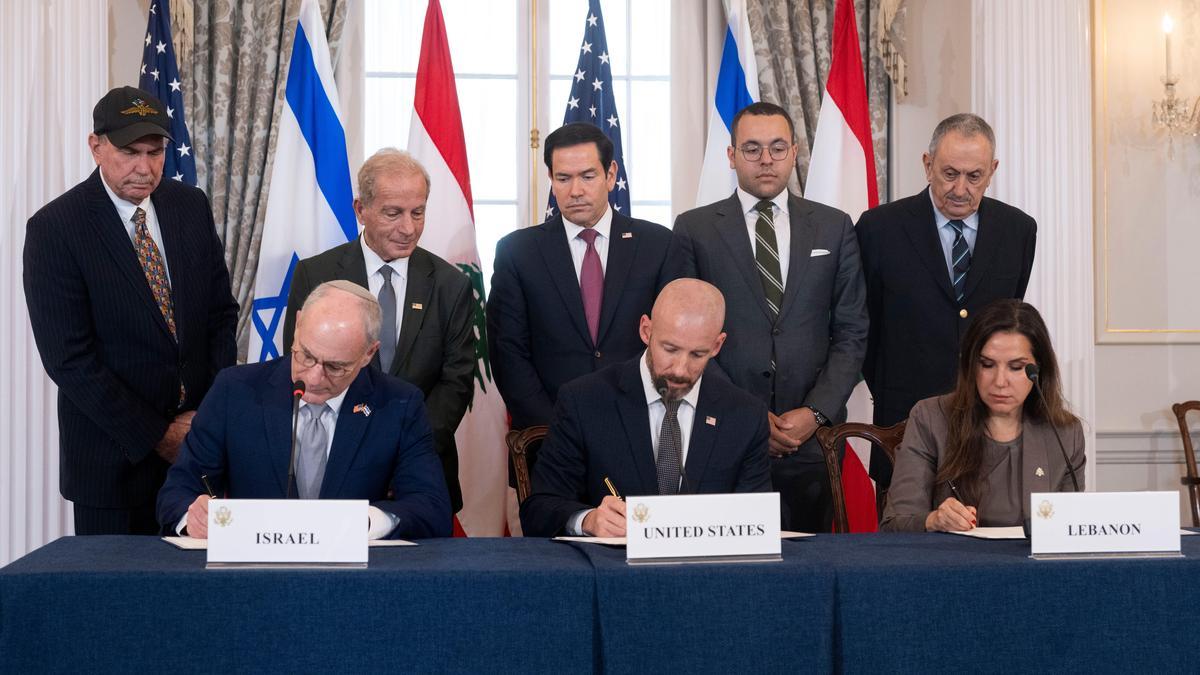
Lebanon, Israel and the United States on Friday (June 26, 2026) signed a trilateral framework agreement aimed at paving the way for a peace deal between the two long-time West Asia adversaries.
The agreement — which includes a pilot effort in which Lebanese soldiers take control of two areas occupied by Israel, as well as a process aimed at disarming Hezbollah — is the result of five rounds of talks in the U.S. capital.
The deal “begins to put in place a framework for lasting peace and security,” U.S. Secretary of State Marco Rubio said at the signing ceremony, noting: “It’s the beginning of the beginning. There’s a lot of work ahead.”
Hezbollah supporters took to the streets of Beirut on late Friday (June 26, 2026) in protest at an agreement announced between Israel and Lebanon hours earlier, state media and an AFP correspondent said.
The state-run National News Agency reported that “Hezbollah supporters rode motorbikes through the streets of Beirut”, including a central area near the parliament and along a road leading to the airport “in protest at the framework agreement announced between Lebanon and Israel”, adding that they blocked at least one road with burning tyres.
An AFP correspondent saw people on motorbikes riding and chanting slogans along one road as well as Lebanese army temporary checkpoints set up along several streets in the capital.
U.S. Vice President J.D. Vance said on Friday (June 26, 2026) that “violence will be met with violence” after the U.S. struck Iran in the wake of an attack on a commercial vessel in the Strait of Hormuz.
“If they have disagreements about how the MOU is being applied, they can pick up the phone,” Mr. Vance said on X.
Iran’s Revolutionary Guards said Saturday (June 27, 2026) that they had attacked U.S. sites in the Gulf region in retaliation to American strikes in Iran, according to state television.
The U.S. military had earlier announced that it had struck targets in Iran in response to an attack on a commercial vessel in the Strait of Hormuz, which it attributed to Tehran.
“If the aggression is repeated, our response will be broader than this,” the Guards said, according to a post by state TV on Telegram.
Secretary of State Marco Rubio joined Israel and Lebanon’s ambassadors to the U.S. on Friday (June 26, 2026) to announce a framework agreement that was described as a first step towards peace following months of conflict between Israel and the Lebanese militant group Hezbollah.
The agreement does not include Hezbollah and prompted one of the group’s officials in Lebanon to warn of civil war. The U.S. State Department said the framework establishes a process for dismantling Hezbollah and for Lebanon to regain territory that was taken by Israeli forces as they battled the militant group.
The U.S. will facilitate a newly created “Military Coordination Group for Lebanon” to implement the framework, the State Department said, while committing $100 million in humanitarian assistance.
U.S. forces struck Iranian missile and drone storage sites and coastal radar positions Friday (June 26, 2026) after Washington accused Tehran of attacking a cargo ship, jolting a fragile ceasefire as diplomats struggled to contain the war in West Asia.
U.S. Central Command said the strikes were a response to “unwarranted aggression against commercial shipping by Iranian forces” that “clearly violated the ceasefire.”
It described the operation as “a powerful response to yesterday’s attack on a commercial ship that was transiting the Strait of Hormuz.”
Saturday, June 27, 2026